

AI for Data-Driven Innovation: Unlocking New Possibilities

Data-driven innovation involves utilizing data analytics and AI to generate new ideas, improve processes, and create value. It is about making informed decisions based on data insights rather than intuition or guesswork. AI plays a pivotal role…

Data-driven innovation involves utilizing data analytics and AI to generate new ideas, improve processes, and create value. It is about making informed decisions based on data insights rather than intuition or guesswork. AI plays a pivotal role in this process by enabling businesses to analyze vast amounts of data quickly and accurately, uncover patterns, predict trends, and make proactive decisions.

The Role of AI in Data-Driven Innovation

  1. Enhanced Data Analysis
    • AI algorithms excel at processing large datasets, identifying correlations, and providing deeper insights that humans might miss. This capability is crucial for businesses aiming to innovate, as it allows them to understand market trends, customer preferences, and operational inefficiencies.
  2. Predictive Analytics
    • One of the most powerful applications of AI is predictive analytics. By analyzing historical data, AI can forecast future trends, customer behaviors, and market movements. This foresight enables businesses to innovate proactively, staying ahead of the competition and meeting customer demands effectively.
  3. Automated Decision-Making
    • AI-driven automation can streamline decision-making processes, reducing the time and effort required for innovation. By automating routine tasks and data analysis, businesses can focus more on strategic initiatives and creative solutions, accelerating the innovation cycle.
  4. Personalization and Customer Insights
    • AI helps businesses understand their customers on a granular level, enabling personalized experiences and targeted marketing. This deep customer insight is a catalyst for innovation, as it allows businesses to tailor products and services to meet specific needs, enhancing customer satisfaction and loyalty.

Case Studies of AI-Driven Innovation

1. Retail Industry

  • Leading retailers are using AI to optimize inventory management, predict sales trends, and personalize shopping experiences. For example, AI-powered recommendation systems analyze customer behavior and preferences, suggesting products that customers are more likely to purchase, thereby driving sales and enhancing customer experience.

2. Healthcare Sector

  • In healthcare, AI is revolutionizing patient care through predictive analytics and personalized treatment plans. AI algorithms analyze patient data to predict disease outbreaks, optimize treatment protocols, and improve patient outcomes, fostering innovation in medical practices and healthcare delivery.

3. Manufacturing

  • AI-driven predictive maintenance is transforming the manufacturing industry. By analyzing machine data, AI can predict equipment failures before they occur, reducing downtime and maintenance costs. This proactive approach not only ensures operational efficiency but also drives innovation in manufacturing processes.

Implementing AI for Innovation: Best Practices

  1. Data Quality and Management
    • Ensure high-quality data by implementing robust data management practices. Clean, accurate, and well-organized data is the foundation for effective AI analysis and innovation.
  2. Collaborative Approach
    • Foster a culture of collaboration between data scientists, IT professionals, and business leaders. This interdisciplinary approach ensures that AI initiatives align with business goals and drive meaningful innovation.
  3. Continuous Learning and Adaptation
    • AI models require continuous learning and adaptation. Regularly update and refine AI algorithms to keep pace with changing data patterns and emerging trends, ensuring sustained innovation.
  4. Ethical Considerations
    • Address ethical considerations in AI deployment, such as data privacy, bias, and transparency. Ethical AI practices build trust and ensure that innovation benefits all stakeholders.

Conclusion

AI for data-driven innovation is not just a trend; it is a strategic imperative for businesses seeking growth and competitive advantage in the digital age. By harnessing the power of AI, companies can unlock new possibilities, transform operations, and deliver exceptional value to their customers. Embrace AI-driven innovation today, and position your business at the forefront of the future.
Machine learning models for modern data-driven marketing

Data-driven marketing is now in charge. However, the effectiveness of marketing and advertising still needs to be improved. In this blog, we share some solid tips from 10+ years of research by machine learning scientists to all marketing professionals.

Chipotle sales increased by 81% through digital ordering in these difficult days, when many other businesses are experiencing a decrease in sales due to the pandemic.

“Investing in digital over the last several years has allowed us to quickly pivot our business with Q1 digital sales reaching our highest ever quarterly level of $372 million” — CEO of Chipotle, Brian Niccol, said in a statement.

Even in the current difficult situation, not every company is losing, but for sure the winners are those who have prepared for a more efficient and intelligent era.

Advanced technologies, such as machine learning, have been applied to more and more aspects of work. At Wali, we use all types of technology at work, and we think technology is a big part of our life. Our digital marketing service is built around identifying core KPIs, data-oriented technologies and reinforcement learning.

Here are some A.I. models and their possible applications in reality. These models could be easily adapted as a mindset and applied to any marketing campaign.

1: K-Means Clustering

K-Means is one of the most well-known clustering algorithms. In theory, K-Means clustering is a method of vector quantization that aims to partition n observations into k clusters in which each observation belongs to the cluster with the nearest mean. 

Reference: K. Wagstaff, S. Rogers, S. Schroedl, “ Constrained K-means clustering with background knowledge “, Proc. 8th Int. Conf. Machine Learning, pp. 577–584, 2001.

Marketing professionals can utilize this algorithm to create segmentation for all their influencers. Every individual influencer has different characteristics. Grouping them into different segments makes the future match 65% faster. At the Wali tech team, we apply this algorithm to our huge set of influencers. It helps us match influencers more accurately to specific industries or one business.

2: Decision Tree

Decision trees are powerful machine learning models that are widely applied in real-world applications. They are defined by recursively partitioning the feature space, which is very easy to interpret. Enhancing the decision tree using reinforcement learning examines all features of a new data point to update model parameters.

Reference: A. M. Roth, N. Topin, P. Jamshidi, M. Veloso, “Conservative Q-Improvement: Reinforcement Learning for an Interpretable Decision-Tree Policy”, arXiv preprint arXiv:1907.01180, 2019

One of the biggest pain points for influencer marketing is to keep matching the brand with a new set of influencers in a dynamic way. This algorithm can help this situation. By creating a decision tree, any marketing professionals can pick a new set of influencers for a brand in a short time. Combining the decision tree with reinforcement learning, the system continuously updates the corresponding decision trees automatically. For example, at Wali, we first created our own decision tree, then kept reinforcement learning on our decision tree. As we are receiving new data points, we can quickly identify the best time to match a specific influencer to a brand.

3: Logistic Regression

Logistic regression is a statistical model that uses a logistic function to model a binary dependent variable. There are many more complex extensions that are applied to various marketing applications.

One typical application is to use logistic regression to predict customer churn. The prediction result can help businesses maximize the usage of their marketing budget by spending money (such as email, push notification, or limited-quantity promotion) on loyal or potential loyal customers.

Credit: John Sullivan, “Churn Prediction: Logistic Regression and Random Forest”

Many times, we only use the numbers a third party platform provides for us to calculate the performance of marketing campaigns. Marketing professionals can also start calculating the loyalty of a customer set, and evaluate the marketing performance based on a combination of third party results and customer loyalty. The same thing can be applied to customer lifetime value.

At Wali, we track all the values above, then calculate the most valuable set of customers and influencers for the brand. This algorithm helps us to keep our promise of matching accuracy for our client.

The perfect marketing campaign is hard to produce. Data-driven strategies are helping us to find a better answer. We encourage as marketing professionals, our readers will adopt some methods from our blog and use them for their next marketing campaign.

Wali autopilot influencer platform is built with more complex ML models, so your brand can quickly match with the best audience. No recruiting, no negotiation. 

Learn more about our no recruiting, no negotiation autopilot influencer platform at https://mywali.co/influencer.html

Idea Talk: An Efficiency Comparison Between Different Digital Marketing Avenue

Which digital channels are best for you business’ needs? Not all are the same and not all may fit your business.

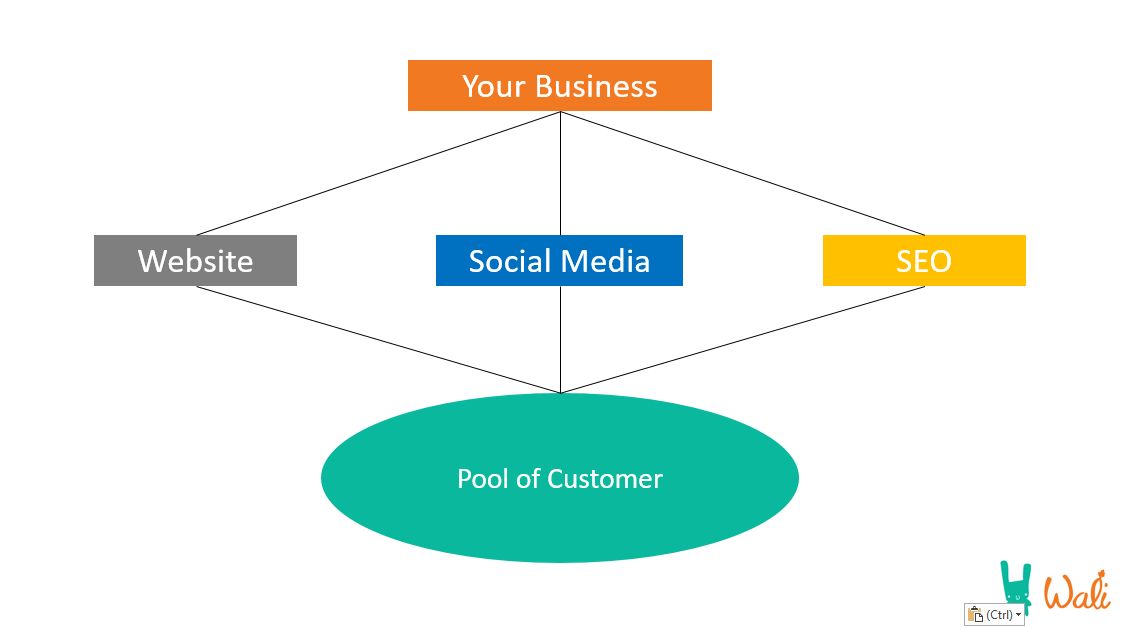
When it comes to digital marketing channels, there sure are a lot of ways for your business to get customers nowadays. For the purpose of focus of this post, we’re going to center our position on three digital channels: Website, Social Media, and SEO. We’re focusing on these three because when we talk to small businesses (including our clients) these three seems to bubble up as the top of mind for many small businesses struggling to understand digital marketing.

Digital Whiteboard

All three digital categories mentioned all serve the same purpose; allowing your customers to find YOU! Just like the traditional method, there are many channels/or ways to reach to your target audiences. But for us here at Wali, it is not a one size fit all methodology. In fact, when working with a lot of small businesses we found that there are niche solutions applicable to each individual companies. We discovered that different companies absolutely need to have a website, whereas others don’t.

Continue reading “Idea Talk: An Efficiency Comparison Between Different Digital Marketing Avenue”